
Logo

IFR spotlights Valk Welding robotic welding cells in Swedish articulated hauler production

The International Federation of Robotics (IFR), known for its annual World Robotics report, has published a case study on a project Valk Welding carried out for Volvo Construction Equipment (Volvo CE). The article describes how Volvo CE moved from a robotic welding system that was approximately twenty years old to Valk Welding cells with four robots per cell and fully offline programming. We are pleased to share a summary of this case study below.

Volvo Construction Equipment (Volvo CE) has implemented new robotic welding installations supplied by Valk Welding as part of its production of load-carrying welded components for articulated haulers. These components are safety-critical and place very high demands on weld quality, repeatability, process stability, and capacity. At the same time, the production environment is characterized by a wide product mix and frequent product changes, making flexibility and robustness essential.

Before the project was initiated, Volvo CE operated a robotic welding system that was approximately twenty years old. Although automated, the solution no longer met modern requirements for flexibility, digitalization, or long-term sustainability.

Volvo CE aimed to increase welding capacity without expanding floor space, primarily by increasing the number of robots per cell. Shorter lead times for new and modified products were a key target, as was the transition to fully offline programming. While productivity improvements were important, the overarching ambition was to establish a future-proof welding platform that could be further developed over time.
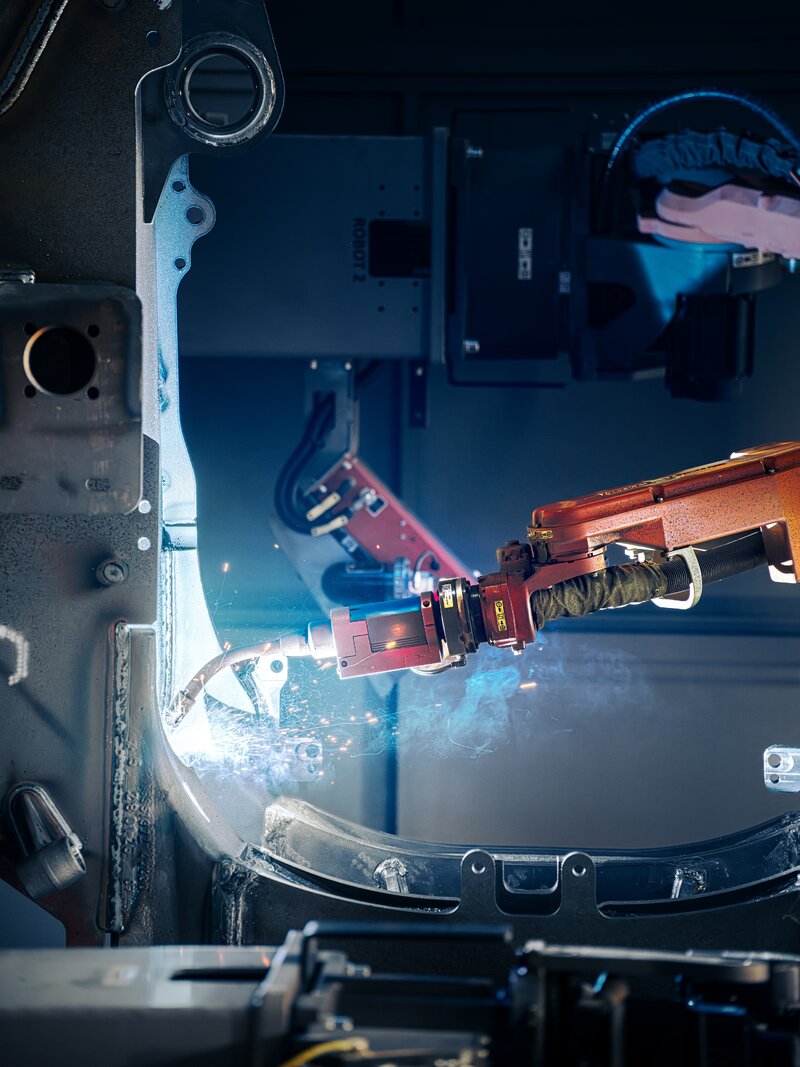
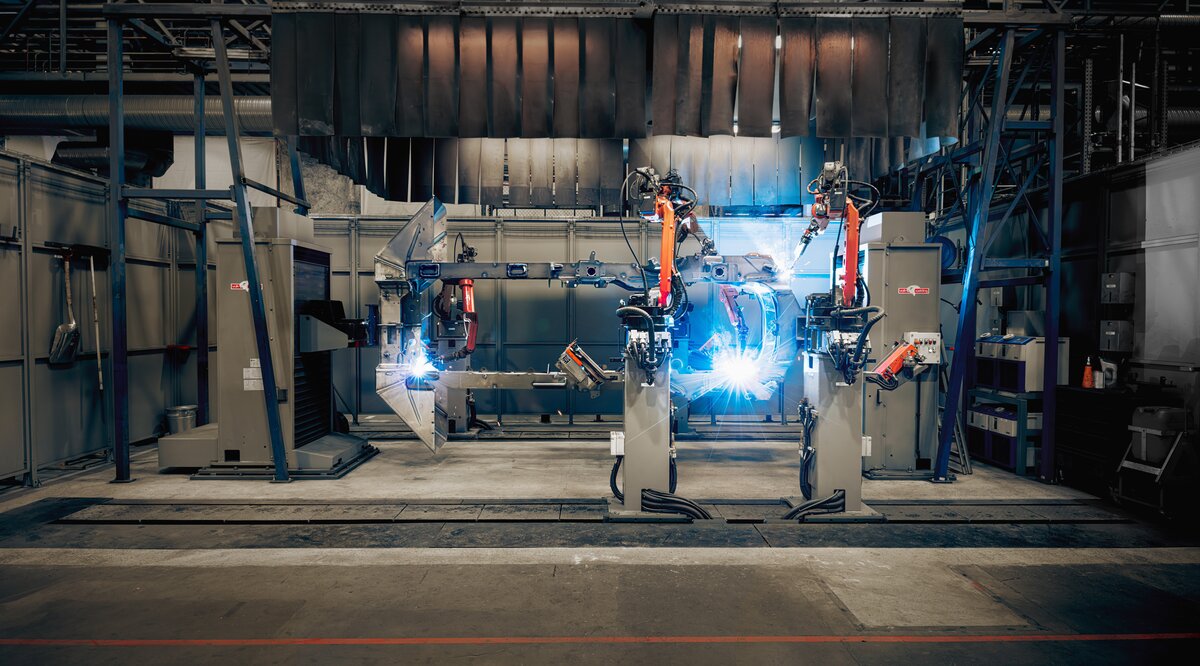
The new solution consists of Valk Welding robotic welding cells adapted for large frame welding applications. A central element of the system is full support for offline programming using DTPS, combined with integration to the Management Information System (MIS) and Shop Floor Control (SFC). Robot programs are now created, simulated, and validated entirely offline, without impacting production. In addition, the number of robots per cell has increased from two to four, significantly improving capacity and throughput.

After installation and ramp-up, the benefits of the new solution have become clear. Process stability has improved, supported by real-time data and systematic deviation handling. Higher accuracy in calibration and offline programming has reduced production disturbances, and increased automation capability has significantly reduced manual welding time. Together, these improvements have led to higher productivity and more predictable production performance.

In conclusion, the implementation of Valk Welding robotic welding cells has provided Volvo CE with a modern, scalable, and future-proof welding platform. From Volvo CE’s perspective, the project represents a strategic investment that will support manufacturing operations for decades to come.

News

Contact

We like to think along with you in finding solutions for your (welding) automation, welding wires and welding accessories. We are looking for the connection and prefer to be a partner rather than a supplier.