More complex challenges demand sharper software
As ARP is deployed more widely, the nature of the challenges it is used to address is changing too. Where the system was initially applied primarily to relatively straightforward situations, ARP is today increasingly being used for more complex installations and production processes. This places different demands on the software. Not only in terms of processing power, but across the entire user experience, from how a program is built to how it is fine-tuned on the shop floor. This reality has led to a series of focused developments over recent months.
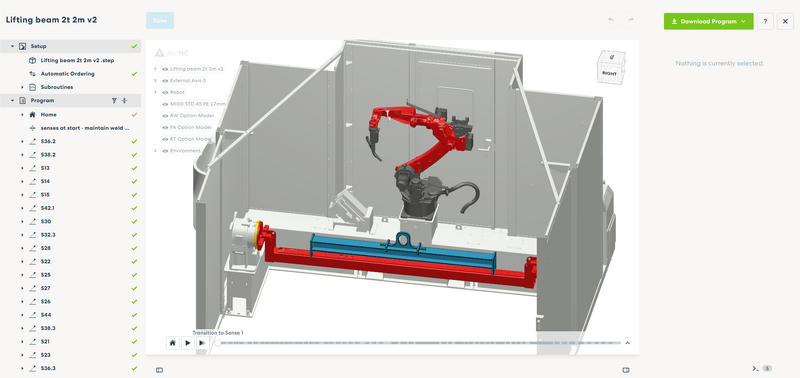
The 3D viewer has been completely overhauled. Visualisations are more accurate, the interface is more intuitive, and working with complex structures feels noticeably more accessible as a result. In parallel, the workflow has been reviewed from the ground up: programs are created more quickly and calculations run more efficiently.
Improvements to touch sensing, the functionality through which the system uses physical contact with the workpiece to program more accurately, make the system more reliable, even in situations where tolerances are tight. And with the introduction of Similarity Detection, a significant step forward has been made. ARP automatically recognises similar welds within a structure. Adjustments no longer need to be applied weld by weld; the system identifies the similarities and applies changes across all matching instances in a single action. A functionality that will be developed further in the months ahead.
Another big development is the motion edit features. With motion edits, programmers gain significantly greater control over robot movements. More customisation, more control, and therefore more scope to tailor the system to the demands of a specific situation. It is precisely the kind of functionality that experienced programmers ask for, and one that makes a tangible difference to the quality of the end result.